
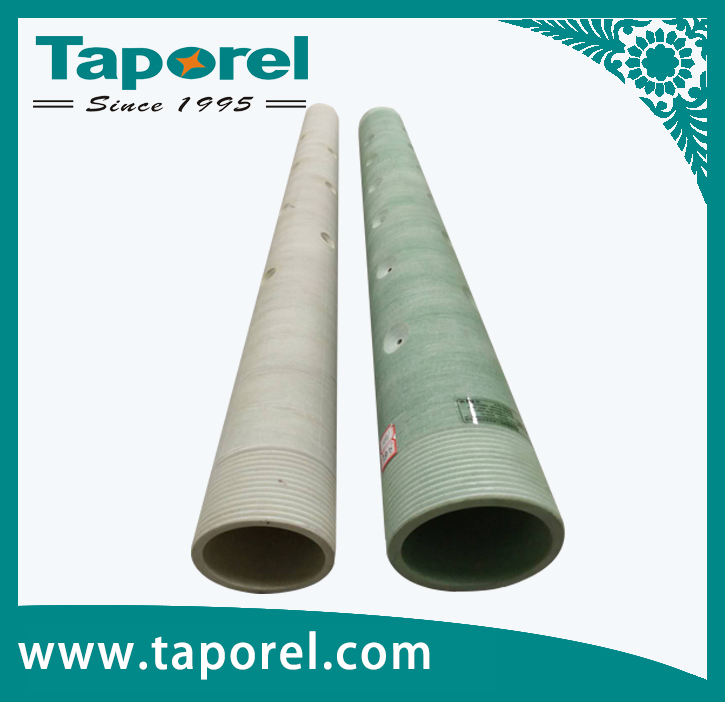
Epoxy Fiberglass Filament Wound Cylinder
1. Product Introduction
The product is a hollow, equal-diameter, cylindrical, integrally molded pipe/tube. It features a standard light green appearance, with a uniformly continuous oblique winding texture visible on the tube wall. One end of the tube can be machined with a threaded section, and the outer wall can be pre-drilled with positioning holes as required. The inner and outer walls are smooth, dense, and uniform in thickness, with no bubbles, delamination, burrs, or exposed glass fibers.
Using E-glass fiber as the reinforcing material, impregnated with high-temperature-resistant epoxy resin, the product is manufactured via a continuous wet winding process, followed by staged heating and curing, and precision machining to produce a seamless insulating tube. The epoxy resin matrix offers excellent insulation, temperature resistance, and aging resistance, while the multi-layer cross-wound structure provides both high mechanical strength and superior electrical insulation performance.
2. Product Parameters
(1) Electrical Insulation Performance
Power-frequency dielectric strength: ≥40 kV/10mm, high breakdown voltage, stable insulation;
Normal-state insulation resistance: ≥10¹² Ω, with no significant degradation in high-humidity or condensation environments;
Low partial discharge, arc-resistant, no conductive precipitate.
(2) Mechanical Properties
Excellent hoop and axial tensile strength, creep-resistant, no delamination or collapse under long-term load;
Impact-resistant and flexural, capable of buffering thermal cycling stresses from equipment;
High structural strength at threaded sections, resistant to thread stripping or cracking under repeated assembly/disassembly.
(3) Temperature Resistance and Flame Retardancy
Long-term continuous operating temperature: –40°C to 130°C, compliant with Class B and F insulation standards for electrical equipment;
Short-term peak temperature tolerance up to 150°C, with no resin softening or flowing under high-temperature conditions;
V0-class flame retardant, self-extinguishing, no molten dripping, compliant with power industry fire safety regulations.
(4) Environmental Durability
Resistant to neutral salt spray and UV aging, no chalking or cracking during long-term outdoor use;
Resistant to transformer oil, lubricating oil, mild acids/alkalis, and industrial dust corrosion;
Chemically stable, with no adverse reactions with insulating varnishes or epoxy casting compounds.
(5) Customizable Dimensions
Customizable inner diameter, outer diameter, overall length, and standard wall thickness. Supports end-threading, locating holes, chamfering, and stepped features with high dimensional precision and concentricity.
3. Product Applications
(1) Power Transmission and Distribution Equipment
Insulating protective sleeves for coil leads in dry-type transformers, high/low-voltage reactors;
Insulating isolation sleeves for busbar feed-throughs and terminal posts in current/voltage transformers, switchgear, preventing phase-to-phase and ground leakage.
(2) New Energy Power Industry
Insulating tubes for high-power transformer windings in photovoltaic inverters and energy storage converters;
Insulating protective components for high-voltage leads inside wind turbine step-up transformers and photovoltaic step-up transformers.
(3) Communication and RF Equipment
Radome/transparent protective tubes for microwave communications and 5G base station antennas;
Insulating isolation cylinders for outdoor RF equipment, with no electromagnetic shielding and low signal loss.
(4) Industrial Specialty Electrical Equipment
Insulating support tubes for traction converters and locomotive reactors in rail transit;
High-voltage insulating sleeves for corrosion-resistant electrical equipment in metallurgical and chemical industries;
Insulating load-bearing cylinders for high-voltage test equipment and diagnostic instruments.
4. Core Functions
(1) Electrical Insulation: High-voltage insulating barrier that isolates high and low potentials, eliminates short circuits and ground faults, and reduces partial discharge;
(2) Mechanical Load-Bearing: Multi-layer wound structure provides tensile, compressive, and flexural strength to withstand axial and radial static stresses during equipment assembly;
(3) Weather and Corrosion Resistance: Resists salt spray, moisture, weak acids/bases, and mold, with no metal corrosion issues;
(4) No Eddy Current Losses: As a non-metallic insulating material, it generates no eddy-current heating during operation, reducing overall temperature rise.
5. Structural Features
(1) Continuous Wet-Wound Seamless Cylinder
Continuous E-glass fiber is cross-wound without interruption and cured as an integral unit, with no spliced or bonded seams, ensuring uniform strength and suitability for various static insulation applications.
(2) 50°–60° Cross-Winding Layout
Oblique multi-layer winding provides bidirectional reinforcement for both hoop compressive strength and axial tensile strength, meeting requirements for radial pressure resistance and axial tension.
(3) Versatile Secondary Processing
Ends can be machined with external threads, tube walls can be precision-drilled for positioning, and both ends can be stepped or chamfered to accommodate various mounting methods including clamps, flanges, and threaded fittings.
(4) Smooth and Dense Tube Wall
Inner and outer surfaces are finely machined and polished, free of sharp edges and glass-fiber burrs, preventing damage to conductor insulation layers during assembly.
(5) Lightweight Insulating Structure
Much lighter than metal sleeves, with no eddy-current losses, reducing overall equipment weight and minimizing operating heat generation.