
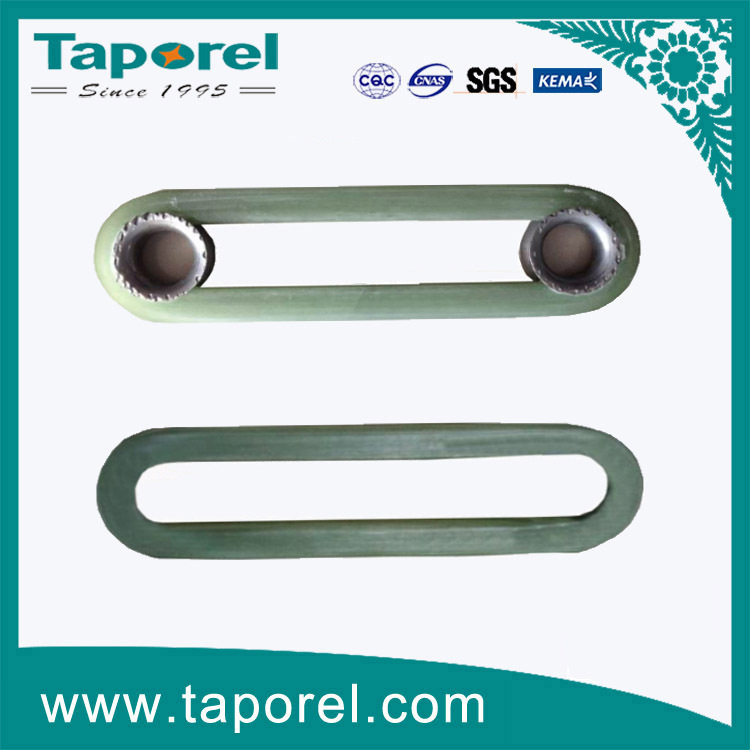
Fiberglass Filament Winding Clamping Ring
The glass fiber wrapped clamping ring is a ring-shaped component made of glass fiber as the reinforcing material and epoxy resin as the matrix, and is produced through the wet winding process. It is mainly used in fields such as high-voltage power transmission, serving as a main load-bearing structural accessory, and functioning to clamp and insulate.
1. Process and Structure
Core Material: Utilize non-alkali and untwisted glass fibers, impregnated with high-temperature resistant epoxy resin solution. Non-alkali glass fibers possess excellent insulation and strength, and when combined with epoxy resin, can exhibit outstanding comprehensive performance.
2. Winding Process: The product is formed through wet winding. The fibers are continuously wound in an uninterrupted manner at an angle of 50° to 60° relative to the axial direction. This specific winding angle design is intended to enable the product to better withstand complex stresses from various directions.
Post-processing: After the winding process is completed, through heating, curing and other procedures, the resin undergoes a thorough cross-linking reaction, ultimately forming a hard insulating product with dense texture and stable performance.
3. Key Features
High mechanical strength: The product has a very high tensile strength and can be used as the main load-bearing component, capable of withstanding significant mechanical loads.
Excellent electrical insulation: It inherits the excellent dielectric properties of glass fibers and epoxy resin, with outstanding electrical insulation performance, making it suitable for use in high-voltage environments.
High-temperature resistant: Utilizing a high-temperature-resistant resin system, it ensures stable performance even under high-temperature working conditions.
4. Main Applications
The main application field is the high-voltage power industry. The typical usage is as a main load-bearing component for high-voltage lines or equipment, leveraging its high strength and insulation properties to achieve both structural support and electrical isolation functions.